


18 Jun Energy Saving HVAC Systems: Cut Costs Without Compromise
Summary:
If your facility’s energy bills keep climbing and HVAC is the biggest line item, you’re not imagining things — and you’re not alone. Most industrial and commercial operators know the system is inefficient. What they don’t always know is exactly where the losses are happening, which upgrades actually pay off, and how to make changes without shutting down operations to do it. This page walks through the most effective energy saving HVAC systems available today, what the efficiency ratings actually mean in practice, and how the right thermal engineering approach can turn a cost center into a controlled, predictable expense.
Most Energy Efficient HVAC System Types for Commercial and Industrial Facilities
Not all efficient HVAC systems are built for the same environment. A system that works well in a mid-size office building may be completely wrong for a food processing plant, a chemical storage facility, or a water treatment operation running around the clock. The gap between a well-matched system and a generic one isn’t just performance — it’s money left on the table every month.
The main system types worth comparing are variable refrigerant flow (VRF) systems, ductless mini-splits, high-efficiency central air and heat pumps, geothermal systems, and thermal energy storage (TES). Each has a different efficiency profile, upfront cost, and operational fit. The right choice depends on your facility’s temperature requirements, operating hours, load profile, and whether you can tolerate any downtime during installation.
High SEER HVAC Systems: What the Rating Actually Means for Operating Costs
SEER stands for Seasonal Energy Efficiency Ratio. The higher the number, the less electricity the system uses to produce the same amount of cooling. Starting in January 2023, the U.S. Department of Energy updated how HVAC systems are tested and introduced the SEER2 standard, which uses more rigorous real-world conditions. A system rated SEER2 is roughly 4.7% more efficient than a system with the same number under the old rating — so the bar has moved.
For commercial and industrial applications, high SEER HVAC systems typically fall in the 18 to mid-20s range. Premium ductless systems can reach 35 SEER2. The practical difference between a 14 SEER system and a 20 SEER system isn’t abstract — if your facility runs cooling for extended hours, that gap compounds quickly over a year of operation. Over a ten-year period, the energy cost difference between a standard and a high-efficiency system can easily exceed the original cost of the upgrade itself.
The other factor that often gets overlooked is installation quality. Even a high-SEER system loses efficiency if it’s oversized, improperly charged, or connected to leaky ductwork. Duct losses alone can account for more than 30% of energy consumption in space conditioning — which means a 20 SEER unit installed poorly can perform like a 14 SEER unit. Proper load calculation, duct integrity testing, and correct refrigerant charge are what separate a real efficiency upgrade from one that looks good on paper.
From a financial standpoint, the upfront cost of high-efficiency equipment is real, but so is the return. Some industrial HVAC retrofits using variable frequency drives have shown 30% reductions in annual energy consumption, with payback periods as short as seven months. One documented commercial case showed a 52% drop in HVAC energy use — translating to 7.2 million kWh saved and $888,000 in annual savings, with a simple payback of 1.8 years. The Section 179D federal tax deduction and utility rebate programs can further compress that payback window for qualifying commercial and industrial facilities.
Energy Star Ductless Mini Split Systems for Zone Control in Commercial Spaces
Ductless mini-split systems have moved well beyond residential applications. In commercial and industrial settings, they offer something central air systems fundamentally can’t: zone-level control without the energy losses that come with ductwork. ENERGY STAR certified ductless mini-splits use up to 60% less energy than standard electric heating and cooling systems, and because there are no ducts, you eliminate the 30%-plus energy losses that ducted systems routinely experience.
The ENERGY STAR label isn’t marketing — it’s an EPA certification that requires independently verified performance data. For a facility manager evaluating equipment, it’s a meaningful filter. ENERGY STAR certified mini-splits also tend to qualify for utility rebates and federal incentive programs, which affects the real cost of the upgrade.
From an efficiency standpoint, ductless mini-splits can achieve SEER2 ratings between 15.2 and 35, depending on the model. That upper range is significantly higher than what most ducted central systems can reach. Multi-zone configurations allow a single outdoor unit to serve multiple indoor zones independently — which means you’re only conditioning the spaces that need it, when they need it. For large commercial facilities with variable occupancy, shift-based operations, or distinct thermal zones, this level of control has a direct impact on monthly energy spend.
In industrial environments specifically, ductless systems also offer an installation advantage. They don’t require the extensive ductwork modifications that central air upgrades often demand, and in many cases, installation can be completed with minimal disruption to ongoing operations. For facilities where downtime carries a real cost — whether measured in lost production, regulatory compliance windows, or contractual obligations — that matters. The efficiency gains are meaningful, but so is the ability to capture them without stopping the operation to do it.
How Thermal Insulation and Energy Storage Reduce Your HVAC Load
Most conversations about HVAC efficiency focus on the equipment itself — the unit, the rating, the controls. What gets less attention is the thermal envelope the system is working against. If your tanks, vessels, or building envelope aren’t properly insulated, your HVAC system is fighting a losing battle regardless of its SEER rating.
Thermal insulation reduces the heat gain or loss that the HVAC system has to compensate for. In industrial settings, this is especially significant. Storage tanks holding process fluids, chilled water, or temperature-sensitive materials are constant sources of thermal load if they’re not properly insulated — and that load lands directly on your cooling and heating systems.
What Is Thermal Energy Storage and How Does It Cut Peak Demand Costs?
Thermal energy storage (TES) is one of the most effective — and underused — strategies for reducing HVAC operating costs in industrial and commercial facilities. The concept is straightforward: store cooling capacity during off-peak hours, when electricity rates are lowest, then deploy that stored cooling during peak demand periods, when rates are highest. The result is the same level of cooling with a significantly lower electricity bill.
TES systems typically store chilled water — in the range of 25 to 40 degrees Fahrenheit — in insulated tanks designed specifically for this application. During overnight hours, chillers run at full capacity to cool the water. During the day, when demand charges spike, the facility draws from the stored cooling rather than running the chiller at peak load. For facilities in markets with time-of-use electricity pricing, the savings can be substantial.
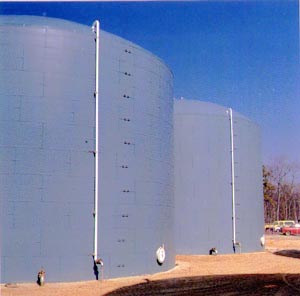
This is where tank insulation and HVAC efficiency intersect in a way that most HVAC contractors aren’t equipped to address. The performance of a TES system depends directly on the quality of the tank insulation. If the stored chilled water gains heat through a poorly insulated tank wall, the system loses its efficiency advantage before the cooling even reaches the building. Proper insulation — engineered for the specific tank geometry, climatic conditions, and operating temperature — is what makes TES viable as a long-term energy strategy.
We’ve been engineering and installing industrial tank insulation systems since 1971, across environments ranging from sub-Arctic Alaska to the Middle East. That experience spans temperatures from -50°F to +500°F and more than 10,000 completed tank installations across petrochemical, food and beverage, wastewater, energy, and water storage industries. When a TES system is part of your HVAC energy strategy, the insulation isn’t a secondary consideration — it’s what determines whether the system actually performs.
ROI on Energy Efficient HVAC Upgrades: What Industrial Facilities Can Realistically Expect
The return on investment question is usually the one that determines whether an upgrade moves forward or stalls in the planning phase. The honest answer is that ROI varies — it depends on your current system’s efficiency, your facility’s operating hours, local electricity rates, and how well the new system is sized and installed. But the data from industrial and commercial upgrades is consistent enough to give a realistic picture.
The U.S. Department of Energy estimates that commercial buildings can reduce energy costs by up to 40% by upgrading to energy-efficient HVAC systems. That’s a ceiling, not a guarantee — but it reflects what’s achievable when the right system is matched to the right facility and installed correctly. For facilities that currently rely on aging equipment, oversized units, or systems with significant duct losses, the savings potential sits toward the higher end of that range.
Variable frequency drives are one of the highest-ROI retrofit options available. AC drives typically reduce HVAC energy consumption by 20 to 50%, and some industrial installations have shown payback periods of under a year. High-SEER equipment replacements tend to have longer payback windows — typically two to five years — but the combination of lower operating costs, available tax incentives, and utility rebates compresses that timeline meaningfully.
One factor that often gets underestimated is installation quality. The ACCA’s Quality Installation Specification exists because oversizing, improper charging, and duct leakage are common enough problems that federal buyers are now required to mandate compliance with it. A system that’s installed without proper load calculation or duct testing won’t deliver the projected savings — which is why the contractor’s technical depth matters as much as the equipment spec. For industrial facilities with complex thermal environments, the engineering behind the installation is what separates a real efficiency gain from one that looks good in a proposal.
Choosing the Right Energy Saving HVAC System for Your Facility
The most important takeaway here is that energy efficiency in HVAC isn’t a single decision — it’s a combination of the right equipment, the right sizing, proper installation, and the thermal environment the system operates in. Any one of those factors, handled poorly, undermines the rest.
High SEER equipment, ENERGY STAR certified ductless systems, VRF configurations, and thermal energy storage each have a legitimate place in an industrial or commercial efficiency strategy. Which one fits your facility depends on your operating conditions, your load profile, and what you can realistically implement without disrupting operations.
We’ve been doing this work for over 50 years, across some of the most demanding environments in the world. If you’re evaluating an upgrade and want to talk through the specifics — including how tank insulation and TES fit into the broader picture — reach out and let’s have a straightforward conversation about what actually makes sense for your facility.